







Employee engagement has fallen for a second year in a row, and it’s not showing signs of improvement on its own. Expectations continue to rise for employees as they work to increase their productivity, output, and impact on the company’s mission.
But expectations without support don’t drive performance; they erode it. Without a clear mission and a demonstrated investment in employee wellbeing, there’s little reason for employees to go beyond the minimum.
Especially as the productivity-pay gap continues to widen, reshaping how employees perceive the value of their work. The Economic Policy Institute’s findings highlight a persistent disconnect between rising output and stagnant compensation: since 1979, worker productivity has increased by roughly 92%, while hourly pay has grown just 33%–making productivity growth about 2.7 times higher than wage growth.
That disconnect is more than a statistic. It’s a signal. Focusing solely on output, without investing in people, leads to disengagement–even when productivity rises.
At the same time, organizations are pouring billions into AI. Yet most aren’t seeing returns, and employees are left navigating change without support. That continued focus on the bottom line has created divide, leading to a historic drop in employee engagement, despite rising productivity.
Over time, that imbalance reframes how employees interpret their contributions. Not as progress, but as a diminishing return. When people consistently give more without seeing proportional reward, motivation shifts from purpose-driven to transactional, weakening engagement, trust, and willingness to go beyond baseline expectations.
Now, the responsibility sits squarely with employers. As AI-related initiatives continue to absorb high costs and significant time investment, the human element can’t be deprioritized. Research from MIT underscores this reality: despite a $30–40 billion investment in GenAI by enterprise businesses, 95% are not seeing a return. Technology alone isn’t driving impact—people are. 2026 is the year that the focus must shift from tech to employees, and a holistic, people-first benefits system is a meaningful first step.
In this article, we’ll cover how employee wellness challenges can rebuild engagement, strengthen connections, and drive measurable business impact.
Wellness challenges are designed to improve health, but they can also support broader engagement goals across the business.
Here’s what we’ll cover:
- What is an employee wellness challenge?
- How employee wellbeing challenges support engagement and business success
- The different types of employee wellness challenges and where to start
- What’s next for employee wellness challenges?
What is an employee wellness challenge?
An employee wellness challenge is an event or task that supports employee wellness in the workplace, designed to encourage and reward healthy habits. These challenges can take many forms, from movement goals to mental health resets to community-driven initiatives. And they all serve the same purpose: creating momentum around employee wellbeing.
Unlike traditional wellness programs, which often feel passive or disconnected, workplace wellness challenges are interactive, social, and measurable. They give employees a reason to participate, and a way to track progress, stay accountable, and engage with their peers.
Employee wellbeing challenges turn wellbeing from a benefit into an experience, reducing stress and directly impacting employee engagement.
How employee wellbeing challenges support engagement and business success
Gallup’s State of the Workplace Report for 2026 finds employee engagement at its lowest point since 2020, rivaling levels of disengagement during and immediately following the pandemic. While engagement remains higher than in years past (20% of employees engaged in 2026, vs. 12% in 2009), this is the only time it has declined for two consecutive years. It’s clear: a problem has emerged, and without action, it will continue to worsen.
This trend is especially noticeable among managers. As workloads increase and engagement declines, it trickles down to their teams. To address this challenge, leadership must—ironically—find meaningful ways to challenge and engage employees. Gallup’s research finds a direct connection between manager engagement and organizational success. In organizations with best-practice lifestyle benefits and programs, around 80% of managers report being engaged–nearly four times the global average.
Employee wellness challenges are well-suited to strengthen these connections between managers and employees. They bring teams together through friendly competition while offering a break from day-to-day pressures. Despite 94% of employers positioning wellbeing as a core part of their strategy, employees are still looking for more meaningful engagement.
Among Espresa’s clients, when teams have access to incentivized challenges and community-based programs, engagement exceeds 80%, again, nearly quadruple the global average, according to Gallup. So why do wellbeing and challenges consistently make an impact?
With the right vendor partner, wellness challenges present few administrative hurdles and are highly customizable, ensuring they remain relevant and meaningful. Whether teams are incentivizing yearly physicals, like Espresa client, JM Family, launching movement challenges, or encouraging digital disconnection, these programs can be tailored to specific needs. And for finance teams, they offer a clear advantage: even lower budget programs can drive meaningful improvements in employee wellbeing.
Workplace challenges and wellbeing: The cost of stagnation
The truth is clear: ignoring employee wellbeing and engagement isn’t only bad for sentiment, it’s bad for business. Employee wellness challenges support wellbeing, which drives engagement, which in turn influences productivity. With wellness challenges, employers can encourage a positive cycle of wellness and positivity, instead of burnout and resentment.
Gallup research reinforces this, with low engagement costing nearly $10 trillion in lost productivity–at a time when productivity growth continues to outpace wage growth. But a comprehensive system of engagement tactics and wellbeing resources can support the mission.
Read next: What’s a Total Rewards Strategy?
As far back as 2013, the National Library of Medicine highlighted the impact of comprehensive employee engagement, noting measurable improvements in both health and wellness. Their findings noted that effective programs must be intentional—legally sound, ethically grounded, and designed to support both physical and mental health.
Corporate wellness challenges are built with this goal in mind—enhancing a company’s foundation of wellbeing. Today, with more advanced tools and programs available, organizations can implement effective challenges simply while reducing workload for HR teams.
The different types of employee wellness challenges and where to start
Employee wellness programs offer a wide range of opportunities, each program curated and crafted by HR teams and executive leaders. Their real strength lies in that diversity of choice, allowing organizations to address specific needs in their workplace.
Many Espresa clients, like The Wonderful Company, have found success by integrating employee wellness challenges with their Lifestyle Spending Account (LSA). This creates a unified hub for wellbeing challenges, where challenges and benefits work together to reinforce engagement.
That interconnectedness drives results. At The Wonderful Company, challenge engagement reached 63% among mobile-first agricultural workers and 60% among corporate employees. These were two distinct groups, unified in their wellness goals. So, where should organizations start?
Common Challenges
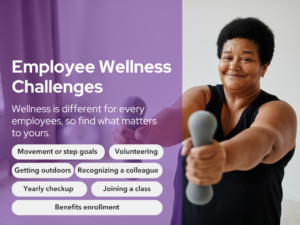
Wellness challenges are designed to improve health, but they can also support broader engagement goals across the business.
- Movement or step goals
- Getting outdoors
- Completing a yearly checkup
- Joining a new hobby-based class
- Recognizing a colleague
- Enrolling in new benefits
- Volunteering
Incentivized challenges
Incentivized wellness challenges follow the same structure and include a monetary reward for participation or completion. These incentives can help encourage behaviors that are often deprioritized—like scheduling annual physicals, taking breaks from screens, or maintaining consistent movement goals.
Regardless of the activity, incentives provide a tangible benefit for participation, helping employees stay engaged while reinforcing healthy habits. Wellness challenges are most effective when they’re positioned as a time- and cost-saving investment, not an added burden. At their core, they’re a strategic investment in an employee wellbeing infrastructure.
Read Espresa’s SHRM article on the importance of investment in internal benefits systems
What’s next for employee wellness challenges?
Employee wellness challenges aren’t an endgame; they’re a step toward a broader wellbeing strategy. They form a stronger sense of community across teams, encouraging employees to engage beyond their immediate roles and departments.
With their flexibility, organizations can be intentional about what they want to achieve. Some may use challenges as a low-pressure, social way to build connection, while others may focus on higher-impact goals supported by meaningful incentives.
The approach may vary, but the outcome is consistent. When employees feel cared for and respected, especially by their leaders, their sense of connection, loyalty, and belonging grows.