







In 2026, the value of a job is no longer measured by the number on a paycheck. As pay transparency has increased, a profound benefits gap has emerged. Employees are understanding the distinct difference between their base salary vs their total compensation. Unequal access to non-wage compensation, like healthcare subsidies, flexible work arrangements, and caregiving support, is creating a new class of financial and quality-of-life disparities.
This year, three forces are eroding the American paycheck: spiking healthcare premiums, rising electricity rates, and persistent inflation on daily essentials. And an employer’s ability to provide benefits, equity, and protect workers from these costs is a stronger wealth-builder than a traditional 3% raise.
In this article, we’ll break down how future-focused leaders recognize total compensation value and embrace flexible and fringe benefits as the great equalizer. By shifting from one-size-fits-all benefits to more flexible programs, organizations are closing the benefits gap and building a more resilient, equitable, and loyal workforce.
Flat wages and rising essential costs mean that an employee’s disposable income is increasingly dictated by their benefits package.
Here’s what we’ll cover:
- The 2026 context: why salaries aren’t enough
- The power of supportive employee benefit packages
- Base salary vs total compensation—the real-life value of total rewards
- The rise of fringe benefits and stipends: How they directly improve retention
- Turn your benefits strategy into a powerful competitive advantage
The 2026 context: why salaries aren’t enough
For the first time in over a decade, salary increases are projected to remain flat at a modest 3.5%. Meanwhile, the cost of employer-sponsored health insurance is surging by at least 10%. Flat wages and rising essential costs mean that an employee’s disposable income is increasingly dictated by their benefits package.
In 2026, the benefits gap is increasingly defined by the stratification of access. While salary transparency has made base pay more equitable, the real value of employment—flexibility, health protection, and time—is diverging sharply between different employee classes.
According to SHRM benchmarking data, the total cost of hiring a new employee can be three to four times the position’s salary. With 20% of employers expecting that as much as one-fifth of their workforce is likely to leave their company, investing in employee wellbeing initiatives yields significant returns beyond simply reducing turnover costs.
Today’s employees consider wellbeing programs a must. Prioritizing holistic health initiatives emerges as a strategic imperative for businesses seeking to attract, retain, and cultivate a thriving workforce.
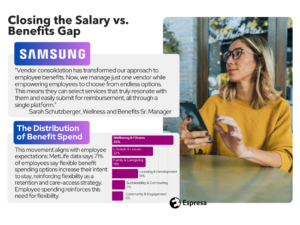
The benefits gap is also widening the future-readiness, resilience, and financial wellness of the workforce.
The power of supportive employee benefit packages
1. Health insurance
Surging health insurance costs are the primary driver of the emerging employee benefits gap in 2026. As employers increasingly manage record-breaking spikes. Shifting expenses onto employees results in higher premiums, increased deductibles, and larger out-of-pocket maximums for the average worker.
Lower-income employees may be forced into high-deductible plans. These plans trade lower monthly costs for the heightened risk of financial instability in the event of a medical emergency. Rising healthcare costs eat up a disproportionately larger percentage of take-home pay for lower-wage workers, effectively functioning as a hidden income gap. A $3,000 increase in annual healthcare costs is a minor inconvenience for a high earner but effectively represents a devastating 5% pay cut for someone earning $60,000.
2. Remote vs. on-site work: the flexibility premium
The benefits gap is most visible in the disparity between remote-capable and on-site roles. In 2026, flexibility is no longer just a perk; it is high-value currency. This has created a new class of benefit-poor workers whose jobs require physical presence.
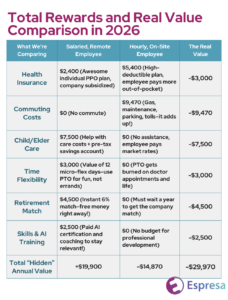
On-site workers effectively pay a commuter tax for fuel, maintenance, and parking. That can cost employees $9,470 a year on average. A remote worker effectively receives a shadow raise simply by avoiding these costs. This is a benefit rarely compensated for in the base pay of on-site staff.
Remote and hybrid workers in 2026 use asynchronous schedules to manage real-life dentist visits or school pickups without touching their PTO. On-site workers must use formal sick or vacation hours for the same tasks. By the end of the year, the remote worker still has a full PTO bank, while the on-site worker is time-bankrupt. The result is a massive time and wealth gap between employee classes.
3. The caregiving cliff
As the sandwich generation, Gen X and Millennials, hits its peak in 2026, caregiving support has become a critical divider between benefits haves and have-nots.
Elite employee benefit packages now include backup childcare stipends and eldercare navigation services. These benefits prevent workforce retreat, where employees, especially women, are forced to quit their jobs to care for family members.
According to 2024 data from Care.com, employees whose companies offer child care benefits report an average out-of-pocket savings of $2,727. Employees without caregiving benefits face care deserts, which force them into a vicious cycle of absenteeism, reduced earning potential, and fewer advancement opportunities.
4. Financial wellbeing
The benefits gap is also widening the future-readiness, resilience, and financial wellness> of the workforce. Companies offering AI literacy training and upskilling stipends as part of their total rewards are essentially giving their employees an insurance policy against job loss.
Salaried workers often benefit from automatic 401(k) enrollment with high employer matching. Hourly workers, due to high-turnover policies or eligibility cliffs, like waiting 12 months to qualify, often miss out on years of compound interest, creating a wealth gap that persists long after they leave the job.
Two employees might have a similar base salary, their lifestyle and financial security are dictated by the … shadow value provided by elite benefits.
5. Mental health
The 2024 Headspace Workforce State of Mind report highlights growing awareness among leaders of these pressing issues. A staggering 90% of CEOs express concern about their workforce’s ability to adapt to changes, while nearly half (49%) of HR leaders report a rise in mental health-related leaves of absence.
By investing in dynamic mental health and fitness programs, such as growth mindset training and mindfulness and meditation resources, employees are empowered to cultivate resilience, navigate challenges with confidence, and maintain unwavering focus at work.
Base salary vs total compensation—the real-life value of total rewards
To cultivate a highly engaged workforce, support employees as they navigate the dynamic relationship between work and personal life. Focusing on outcomes rather than strict adherence to schedules allows employees to find the most effective ways to work within their circumstances. A workplace that embraces autonomy and flexibility enables employees to flourish and reach their full potential.
In 2026, the gap between compensation and the real-life value of total rewards has reached a tipping point. While two employees might have a similar base salary, their lifestyle and financial security are dictated by the $15,000 to $25,000 shadow value provided by elite benefits. This benefits gap highlights that an employee’s total rewards package can be highly unequal, even as base salary gaps narrow under pay transparency laws, such as California’s SB 1162.
A high-quality benefits package provides a real-world financial shield. Student loan help, emergency savings programs, or high retirement matching directly boost long-term wealth. Generous paid parental/caregiver leave and unlimited PTO (for those who can truly take it) improve life quality and reduce external costs.
An employee with a salary of $40,000 and a high-deductible, low-quality health plan is in a far more financially precarious position than an employee with a salary of $65,000 and a comprehensive, fully-paid plan. Today, the difference in benefits value is the most impactful factor in employees’ long-term financial health and security.
The Bottom Line
In 2026, pay equity is no longer enough. An on-site salaried worker earning $65,000 is effectively “poorer” than a remote worker earning $50,000 once you factor in the massive financial drain of commuting, healthcare premiums, and lost time.
The rise of fringe benefits and stipends: How they directly improve retention
To meet the needs of a multigenerational workforce, forward-thinking leaders found Lifestyle Spending Accounts (LSAs) and other fringe benefits. It should not be a stipend vs salary—instead, they can work together to create a unified employee experience.
Stipends allow a Gen Z worker to pay student loans, while a Millennial parent uses the funds for childcare. And offering presence stipends to on-site staff can offset the real cost of coming to work, bringing their net take-home pay back in line with their remote counterparts. Standardized stipends ensure that every employee, regardless of role or location, receives the same benefit dollars. Whether it’s mental health, eldercare, or professional upskilling.
These more fringe benefits, like LSAs, Recognition, Wellbeing, and Communities, all directly improve an employee’s tenure. By enabling one employee benefits platform, Espresa clients are seeing:
- 14.5% improved retention with multiple Espresa programs enabled
- 12% improved for LSA users
- 11% improved for Wellbeing
- 6% for Recognition
And that’s why base salary vs. total compensation is so vital. Without any additions to an employee’s salary, forward-thinking employers can reinvigorate their workforces and add meaningful support.
Turn your benefits strategy into a powerful competitive advantage
As costs of living and healthcare outpace salary, organizations must replace outdated models with radical personalization.
Leaders must make sure personalization is not a privilege. Meaningful flexible benefits ensure equity for all employees. By embracing the flexibility of Lifestyle Spending Accounts, companies can ensure that every employee, no matter where they are, enjoys a total rewards package that protects their wellbeing and financial security.
Empowering your global workforce with inclusive, personalized benefits. Connect with Espresa today to request a demo and see how the all-in-one LSA Plus™ platform can turn your benefits strategy into a powerful competitive advantage.
Frequently Asked Questions
What is the real difference between salary and total compensation?
Salary alone often refers to an employee’s base pay, excluded from their benefits. Conversely, total compensation analyzes all factors of compensation, from an employee’s salary, benefits, wellness incentives, career development, and so on. Total compensation also takes into account the unique expenses employees may incur while working, like commuting stipends or meal cards.
How does total compensation impact retention?
Total compensation is directly tied to employee engagement and retention, and according to Espresa’s internal data, employees are 14.5% more likely to stay at their current role when they had 2 or more wellness programs active (Lifestyle Spending Accounts, Rewards and Recognition Programs, Communities, Wellbeing). All without significant changes to their salary.
What benefits close the gap for employees?
Each team will resonate with different benefits, but to start, many employers leverage Lifestyle Spending Accounts for their broad applications. And since Espresa can implement other benefits off cycle, it gives employers to option to augment their program and learn how their employees use the program.