







Throughout the month of February, Black History Month invites organizations to pause, learn, and celebrate the history, culture, and contributions of Black communities. It’s a moment to honor both progress made and the voices that continue to shape workplaces and society today.
For employers, celebrating Black History Month at work is an opportunity to foster belonging, encourage learning, and bring teams together–whether in-person, remotely, or in a hybrid environment. With thoughtful planning, people leaders can create experiences that feel authentic, inclusive, and impactful long after February ends.
In this article, you’ll learn how to celebrate Black History Month at work by organizing initiatives across key focus areas–supporting education, employee voice, community impact, and long-term employee wellbeing and belonging.
Most importantly, ask employees what Black History Month means to them and how they prefer to engage. Centering employee voices helps ensure celebrations feel respectful and relevant, while reinforcing a culture of inclusion, trust, and belonging.
Here’s what we’ll cover:
- The history and significance of Black History Month
- How to thoughtfully celebrate Black History Month at work
- Why does celebrating Black History Month matter at work?
- Building cultural awareness beyond Black History Month
The history and significance of Black History Month
Black History Month traces its origins back to 1915, when thousands of African Americans traveled to Chicago to attend exhibits highlighting the achievements of Black people since the end of slavery. These events inspired historian Carter G. Woodson to later establish the Association for the Study of Negro Life and History, which introduced the first Negro History Week in February 1926.
Fifty years later—following decades of civil rights activism—in 1976, Negro History Week officially expanded into Black History Month. Today, a century after its beginnings, Black History Month is recognized around the world as both a celebration of progress and a reminder of the ongoing work needed to advance equity and understanding.
To meaningfully celebrate Black History Month at work, both employers and employees must commit to continued learning—not just during February, but year-round.
Supporting learning that builds employee wellbeing and belonging
Understanding cultural context is essential when recognizing any historic moment. Learning foundational concepts, like the difference between “Black” and “African American”—can be a helpful starting point, but it shouldn’t replace listening to how individuals self-identify.
Most importantly, ask employees what Black History Month means to them and how they prefer to engage. Centering employee voices helps ensure celebrations feel respectful and relevant, while reinforcing a culture of inclusion, trust, and belonging.
How to thoughtfully celebrate Black History Month at work
To honor Black History Month authentically—especially across diverse or distributed teams—employers should prioritize experiences that educate, amplify employee voices, support communities, and reinforce inclusion beyond February.
Organizations often find the most success when Black History Month initiatives are organized across a few core focus areas:
Learning, education, and awareness
Educational experiences help employees deepen their understanding of Black history, culture, and contributions.
- Host guest speakers, workshops, or panel discussions featuring historians, educators, or community leaders
- Organize lunch-and-learns that encourage dialogue, reflection, and shared learning
- Create optional book clubs with curated reading lists that explore Black voices and perspectives—consider offering incentivized rewards to encourage participation
- Curate playlists celebrating Black artists and cultural influence of Black music
- Introduce interactive learning through trivia or culturally relevant games, like Spades, that blend education with connection
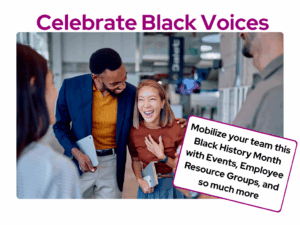
Employee-led stories and perspectives
Centering employee perspectives ensures celebrations feel authentic and employee-led.
- Partner with employee communities (ERGs) or culture committees to co-create programming
- Invite employees to recommend speakers, books, films, or music that feel meaningful to them
- Create opportunities for employees to share insights or cultural reflections on a voluntary basis
Extending impact into the community
Black History Month is also an opportunity to support organizations and causes beyond the workplace.
- Highlight nonprofits that support Black communities and invite employees to share organizations that matter to them
- Offer donation matching to amplify employee contributions while respecting time and workload constraints
- Encourage participation in community initiatives that align with company values and employee interests
Strengthening workplace culture and belonging
Thoughtful programming can strengthen connection, inclusion, and belonging across teams.
- Create shared experiences that bring employees together through discussion, learning, or cultural exploration
- Design initiatives that allow for flexible participation across in-person, hybrid, and remote teams
- Encourage leadership visibility and participation to reinforce organizational commitment
Economic support and community investment
Thoughtful economic support can help extend celebration beyond the workplace and into the communities employees care about.
- Support Black-owned businesses through stipends or Lifestyle Spending Accounts (LSA) employees can use in ways that feel most meaningful to them
- Fund museum passes or cultural experiences, allowing employees to engage with Black history at their own pace during the workday

Why does celebrating Black History Month matter at Work?
Celebrating and uplifting diverse voices is how unique ideas, perspectives, and forms of expression take shape. In the workplace, diversity and understanding are foundational to growth, and that growth begins with learning.
Honoring Black History Month at work may also encourage employees to share their own cultures and experiences, fostering dialogue and strengthening community. When employees feel seen and valued, engagement, trust, and retention naturally follow.
Building cultural awareness beyond Black History Month
Creating a diverse and supportive work environment takes more than one month of activities or a single initiative. It requires ongoing learning, flexibility, and support to truly diversify the core of your workforce. But the importance of programs and times like these does not end in February.
When thoughtfully approached, Black History Month isn’t a one-time celebration, it’s a starting point. By continuing to engage employees and invest in meaningful experiences throughout the year, organizations can build cultures that support belonging and wellbeing.
With Espresa, companies can turn intention into action–funding meaningful experiences, supporting employee needs, and reinforcing culture year-round through flexible benefits and specialty allowances.