







Employees who seek out opportunities to learn and build new skills demonstrate initiative and a commitment to growth. But when their motivation and dedication are met with a lack of internal resources, data suggests that they may begin looking elsewhere for opportunities to grow their careers. For employers, supporting that growth means giving employees practical, accessible ways to continue learning throughout their careers. Professional development stipends offer one flexible approach, providing employees with resources to build relevant skills while giving employers a structured way to invest in their personal and professional development.
Professional development has become increasingly important, especially as businesses eye tuition reimbursement benefits for students as a retention strategy. And while that is an equally valuable resource, professional development stipends offer growth opportunities for all employees. They can even extend beyond traditional schooling, offering support for certifications, travel, events, and more.
Many employers successfully integrate their professional development services into a broader benefits plan, encouraging employees to participate in a variety of eligible courses. Some employers incentivize these opportunities, giving employees more money in their Lifestyle Spending Account (LSA) or other benefits wallet to support their development.
As these learning opportunities are built into company benefits, employees can explore more of their professional interests without taking on the full financial burden themselves.
In this article, we’ll cover how professional development opportunities for employees can transform long-term engagement, support the adoption of new company resources and technologies, including AI, and support employee wellness—all while keeping budgets under strict employer control.
Here’s what we’ll cover:
- What are professional development stipends and why do they matter?
- Professional development funding: what’s in it for employers?
- 4 Ways to use professional development stipends for employees
- Avoiding stagnation with employee education benefits: Guiding a career trajectory
- Encouraging growth – A small investment with meaningful payoff
One of the greatest benefits of supporting professional development stipends is the range of learning opportunities they create for all employees, regardless of role or industry.
What are professional development stipends and why do they matter?
Professional development stipends are dedicated funds used to support continued employee education, often including employer-sponsored classes, workshops, certifications, degrees, and more. While they are typically funded by employers, their flexibility allows each organization to take a different approach to administration.
Some employers may host these learning opportunities, allowing employees from all departments to gain new insights within their organization. Alternatively, and more commonly, employers give employees a capped amount they can spend on approved professional development services.
Around 20% of Espresa’s clients offer education or professional development-specific allowances to help employees advance in their careers, representing a significant YoY increase. This growing interest reflects an opportunity for employers to attract, retain, and support employees who want to continue learning. But making that investment requires a delicate examination of each company’s workforce and their needs.
As these benefits become more popular, how are employers funding them—and what do they gain from the investment?
Professional development funding: what’s in it for employers?
Professional development is not simply about allocating thousands of dollars for employees to attend college courses or one-off events. To realize the full value of the investment, employers need to understand why employees want professional development funding.
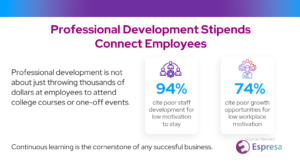
To answer the why, Harvard University conducted research and found that 74% of employees cited a lack of professional development support as a blocker to reaching their fullest potential at work. And 94% argued that they would be encouraged to stay at their current employer if they invested more in staff development.
The National Library of Medicine reinforces this finding with its own research, noting that junior faculty members who participated in a development program were 11% more likely than non-participants to stay at their job. The research points to a consistent connection between professional development opportunities and retention. But when those resources are ignored, it’s not just sentiment that falls—it’s productivity. The lack of investment in professional development stipends often makes employees feel neglected, leading to an increased intention to leave their role.
When employers set aside a budget for professional development and manage it through a trusted and reliable employee benefits platform, they are actively contributing to the longevity of their current workforce. Junior employees can be trained and promoted from within, limiting the need for external hiring to fill new roles. Senior members can connect with other industry professionals, bringing new ideas back into the organization. And even leaders can use a professional development stipend to take courses and strengthen the skills they need to lead their teams.
Across every team, there are opportunities for employees to build skills that benefit both their careers and the organization.
Learn more about the heavy cost of high turnover in our article: The True Cost of Employee Turnover
4 Ways to use a professional development stipend for employees
One of the greatest benefits of supporting professional development stipends is the range of learning opportunities they create for all employees, regardless of role or industry. As new technologies emerge and industries evolve, the need for professional learning evolves with them. AI is a great example, as organizations across industries work to introduce it into their respective workflows. Employees can learn about:
1. AI learning
Artificial intelligence continues to develop rapidly, creating a need for employees to understand the applications most relevant to their work. Rather than force AI adoption, sponsoring opportunities for employees to learn about AI applications may help them build confidence with technology, allowing them to work more efficiently and learn an essential skill.
This approach also gives leaders more time to implement AI responsibly, especially in HR and people-centric teams.
2. Career advancement
Each company will have distinct courses or pathways that support employees. Professional development can encompass a wide range of subjects, creating different opportunities based on employees’ roles and goals. For example, a tech company may find value in encouraging its employees to get certified in a new programming language. Alternatively, a healthcare company may use professional development stipends to fund classes on new healthcare technologies or machinery.
Professional development can also build transferrable skills, such as essential leadership, that apply across roles and career stages—historically attracting younger talent as well.
3. Travel for external events
Not all professional development opportunities have to occur in the workplace. Conferences, speaking events, and more encourage employees to expand their roles and learn more from other industry leaders.
These experiences also give employees opportunities to apply new knowledge in practice settings and build connections within their industries.
4. Memberships to resource libraries
Joining membership-based groups can give employees access to online resources and connections with others in the same industry. Subscriptions to news outlets or blogs may also fit into this category when appropriate. Each employee may find value in a different membership, so ensure your guidelines are clear and oriented around employee education benefits.
Without a clear focus on creating growth opportunities, employees may be less likely to engage with resources or pursue additional learning with their professional development stipend.
Avoiding stagnation with employee education benefits: Guiding a career trajectory
Limited opportunities for growth can contribute to employee dissatisfaction and disengagement. When employees no longer feel challenged or see opportunities to advance, their motivation declines.
According to the American Psychological Association, 23% of American employees are not satisfied with their opportunities for growth. By neglecting this essential aspect of employee success, companies risk contributing to turnover while reducing satisfaction among employees who stay. By introducing a professional development stipend, they can circumvent this problem.

SHRM notes that over 60% of employees with professional development or career growth opportunities are more likely to stay with their employers. Together, these findings reinforce the connection between professional development opportunities and employee retention. Employees want professional development funding, and it’s up to their employers to create meaningful opportunities for them to continue developing their skills.
Encouraging growth – A small investment with meaningful payoffs
For many employers, LSAs have helped address this need, supporting professional development resources and skill-building, all while streamlining access for employees. With a single, dedicated platform, employers can manage their professional development stipend in a single LSA program, creating multiple unique wallets for employees to use. Whether an employee is pursuing tuition reimbursement, attending a conference, or exploring another development opportunity, a comprehensive LSA allows employees to access those options easily.
So as employers work to implement new and innovative professional development resources for their employees, one principle should remain at the center of their strategy: Employees want opportunities to learn and grow. Giving them flexible, accessible ways to pursue that growth can strengthen engagement while helping employers build a more skilled and resilient workforce.
Frequently Asked Questions
What is a professional development stipend?
A professional development stipend is a set budget, created and funded by employers, for employees to use on training, schooling, courses, and other educational opportunities.
What’s the difference between a professional development stipend and tuition reimbursement?
A professional development stipend is much more broad, and often less involved, than traditional tuition reimbursement plans. Instead of retroactively funding student loans or payments, businesses fund educational opportunities for employees. Sometimes, those funds are discretionary, able to be used on anything within the scope of the employer’s plan, and not limited to only formal schooling.
What can employees spend their professional development stipend on?
Each company can set their own parameters around what is eligible for professional development, but often, they cover opportunities like:
- Career coaching
- Degree programs
- In-person events and seminars
- Professional memberships
- And more
How do I administer professional development stipends?
Each company manages their programs differently, but in most successful cases, they often use a dedicated employee benefits platform, so employees can self-serve and research their opportunities in one place. Using direct deposits can be tough to measure, as it doesn’t accurately track what employees use, and thus, gives no greater insight to HR teams.
Why are professional development stipends necessary?
Professional development stipends create opportunities for employees to learn more about their role, skills, and strengths by removing the higher barrier to entry for many employees. And that translates into real retention improvements, guiding employees to continue their learning while adding more and more value to their organization.