







HR is the trusted bridge between employers and employees. By closely monitoring changes that could impact the workforce, HR professionals are the first to protect employee dignity, experience, and fairness. AI has introduced undeniable challenges to that role, raising questions about how to implement AI in HR responsibly, valuing employees’ humanity while also meeting the needs of executive leadership.
For this reason, it’s often not the technology-forward employees who set the organization’s expectations around AI; it’s HR professionals. And that’s an organizational advantage, because HR can champion human-centered AI use cases that improve productivity while protecting employees’ sense of belonging.
Mercer finds that this is actually an advantage, presenting an opportunity to implement AI in HR responsibly while elevating HR professionals, removing barriers, and giving them more time to support the human condition, which, in turn, supports the bottom line.
In this article, we’ll discuss how to implement AI into HR responsibly, optimizing its use as a productivity enhancement tool that preserves employee trust rather than eroding it.
AI tools in HR thrive with responsible and thorough implementation.
Here’s what we’ll cover:
- AI’s role in employee benefits—Enhancing personalized programs
- The do’s and don’ts of using AI in Human Resources (some things deserve the extra time)
- Preserving employee trust—Establishing AI principles and guardrails
- AI vs. personal experience—Something only humans can do
AI’s role in employee benefits—Enhancing personalized programs
Implementing AI into HR responsibly starts with defining its functionality. For each organization, that role may look different, but in employee benefits, AI works best when it enhances personalized programs and eliminates administrative tasks. AI streamlines benefits. Espresa, for example, uses AI as an eligibility assistant and a Rewards and Recognition (R&R) support tool. This allows AI to shine while also reducing barriers for HR teams delivering more customized benefits programs.
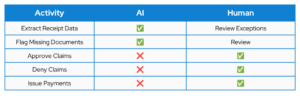
Lifestyle Spending Accounts are a great example of how AI programs can enhance human-centric benefits, assisting HR teams in basic adjudication to simplify the reimbursement process for eligible LSA expenses. When an employee submits a claim, Espresa’s Eligibility Advisor will cross-reference the request with the employee’s eligible expenses, ensuring their request meets the organization’s standards. The final decision always lies with a human, who can see the nuance in a request.
A dual-pronged approach works best, vetting initial requests while still maintaining a final pass from someone who understands the program, and the people it serves. With that, the human aspect of HR remains at the center—just better supported. Especially as personalization thrives more than ever, AI capabilities can create a simpler benefits environment while expanding access to meaningful resources.
The do’s and don’ts of using AI in Human Resources (some things deserve the extra time)
AI tools in HR thrive with responsible and thorough implementation. Without formalized processes or employee wellness softwares in place, AI can quickly slip into too many ambiguous areas, ultimately harming the employee-employer relationship. Trust, transparency, and data protection are the most foundational to AI adoption in HR and employee benefits.
Espresa’s framework is built on our HITL governance. That’s “Human-in-the-Loop,” ensuring AI functions strictly as an assistive tool, providing guidance on claims while ensuring people make the final decision for other humans.
Curious about Espresa’s AI roadmap and approach? Fill out our form on our Consultants page and ask for the AI Implementation Guide!
But for any company, there are a few basic guidelines when implementing AI in HR responsibly.
The DON’TS of AI and HR
To ensure fairness, humanity, and avoid historical bias in AI, take care to avoid:
- Using AI to make personal decisions for others
- Forcing employees to implement AI where it doesn’t work for them
- Issuing payments
- Approving or denying claims without final human adjudication
- Overruling human decision-making
- Using AI to help with personal problems
The DO’S of AI and HR
AI thrives in black-and-white decision-making, not analyzing areas of grey or personal nuance. For example, while an AI might deny a claim for pet food, an HR professional might see that as a “family” expense, and thus fitting into the program. Just like text on a screen can never 100% accurately depict tone, AI can never truly replicate human decision-making with our level of empathy and care. So to best utilize AI in HR responsibly, professionals can leverage:
- AI-Assisted Claims Guidance: Helping employees navigate submission requirements effortlessly
- Receipt OCR & Documentation Review: Instantly reading and analyzing submitted documentation
- Recognition & Communication Assistance: Helping managers and peers craft meaningful organizational messaging
- Intelligent Benefit Search & Navigation: Allowing users to find what they need intuitively
- Transparency: Ensure users know what is AI and what is human-made
AI in benefits is designed to focus heavily on assistance, not automation. It serves as an intuitive support layer to simplify employee experiences, never to replace human care. But most importantly, before any AI implementation happens, there must be guardrails and policies.
Preserving employee trust—Establishing AI principles and guardrails
Just like with any new product or implementation, AI implementation needs guardrails. Certain assurances that HR will not use AI in ways that are detrimental to employees Especially as it pertains to their personalized benefits usage. For each organization, those guidelines will be different, catered to each industry, company, size, etc.
Without those guardrails, processes quickly fall apart, ignored in favor of completing a task on time rather than give it the time it needs. GoTo’s recent Pulse of Work Report identifies the gaps AI is leaving behind. When surveying 2,500 global employees and IT leaders, their research found:
- 84% of employees say their company is not doing enough to promote responsible AI usage
- 56% of IT leaders say their company has no formal AI policy
- 43% of IT leaders argue their company is measuring AI ROI poorly
- 65% of employees believe their employer’s human skills suffer from AI overuse
That comes as workers find issues with its usage as well, especially younger generations. SHRM finds that nearly 40% of workers admit AI makes them feel less intelligent, with 30% arguing they can’t function without it.
For this reason, it is essential to establish a “why” for AI usage, as there is baseline skepticism on the value and efficacy it brings to an organization. Especially as research from NBER calls it into question, noting that among 6,000 surveyed senior business executives at US, UK, German, and Australian groups, AI is widespread, but 89% of leaders are reporting no impact on productivity.
AI vs. personal experience—Something only humans can do
AI automates, humans innovate; there are some things that humans will always perform better at. Human Resources is the perfect example. It’s a process built by humans, for humans, so it’s no wonder they know best. And with employee benefits continuing to become more personalized, it’s the ideal time to leverage an efficiency improvement tool like AI.
Because crafting meaningful employee experiences is about knowing what makes the company and its people tick, something AI will never replicate for HR teams.