







Technology drives the human experience at work. When used properly, it creates more connected and equitable experiences—especially through employee wellness software and modern benefits administration.
As healthcare and benefits costs continue to rise, employers are increasingly pressured to do more with less. Mercer found that 59% of employers expect to make cost-cutting decisions to their health plans in 2026, up from 48% in 2025 and 44% in 2024.
But history suggests cutting wellness investments may be shortsighted. Years ago, Johnson and Johnson (J&J) demonstrated that comprehensive employee wellness programs could improve employee health outcomes while reducing healthcare spend. Harvard Business Review reported declines in smoking, inactivity, and high blood pressure among employees after J&J invested heavily in wellness initiatives. Between 2002 and 2008, the company estimated those programs saved $250 million in healthcare costs—returning roughly $2.71 for every dollar spent.
Today, the conversation is no longer about whether employee wellness matters. It’s how organizations can deliver meaningful, scalable support across hybrid, remote, and global workforces. That’s where employee wellness software becomes essential—streamlining administration, expanding access to benefits, and helping employers build healthier, more engaged teams without increasing complexity.
It’s not just a wellness app for employees to use on occasion. It’s a hub for their benefits, which is becoming more and more important as employees continue to identify gaps in their base salary vs. their total compensation.
Here’s what we’ll cover:
- What is employee wellness software?
- Support employees and HR: How wellness platforms encourage self-service
- Why employee wellness software is critical for success
- How to implement an effective employee wellness software
- Defining culture: employee wellbeing in 2026
What is an employee wellness software?
Employee wellness software is a platform or program that consolidates employee benefits, typically for flexible or lifestyle benefits, like Lifestyle Spending Accounts (LSA), wellbeing, challenges, and Employee Resource Groups (ERG), or communities. With a single, accessible platform, employee wellness platforms enable workers to access all of their benefits in one place. But that is not always done with in-house processes.
More commonly, employers partner with third-party vendors to augment their corporate wellness programs, leveraging an existing and historically successful partner to curate employee benefits. Unlike traditional approaches, a dedicated wellness platform can directly target high-impact needs with light administrative effort from HR leaders. Creating new LSA allowances, recognizing colleagues, incentivizing team challenges, leading employee communities, and more—accessible through one universal platform.
Support employees and HR: How wellness platforms encourage self-service
Employee wellness solutions do not only benefit employees—they define modern HR administration. Dedicated platforms encourage employees to self-serve when they run into platform problems, especially if the partner, like Espresa, has their own dedicated support teams.
Consolidated plans consistently outperform disjointed health, benefits, and wellbeing experiences, as noted in research conducted by Business Group on Health. Duplicated efforts, lost time, and inflated costs quickly turn a meaningful benefit into an administrative nightmare. But with one unified employee wellness software across the whole organization, each employee’s experience is the same, yet also curated to their own language, currency, or local vendors.
It’s not just a wellness app for employees to use on occasion. It’s a hub for their benefits, which is becoming more and more important as employees continue to identify gaps in their base salary vs. their total compensation. And with all employees in one place, HR leaders have access to invaluable employee wellbeing analytics that inform program growth over time.
Fewer emails and waiting. More benefits and action.
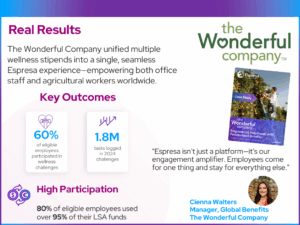
The Wonderful Company highlighted Espresa as an “engagement amplifier” in its employee experience strategy:
Why employee wellness software is critical for success
It’s no secret now. Comprehensive employee benefits improve employee sentiment, which in turn improves engagement and company success. It’s a cycle of growth, where employers leverage diverse benefits to support an employee’s total wellbeing. In response, employee sentiment improves, and productivity rises.
Employee wellness software drives:
Lower absenteeism
Gallup’s research reports companies with high employee engagement experience 23% higher productivity, 18% higher profitability, and 81% less absenteeism than those with less engaged workers. And since employee wellness software has a history of improved employee engagement, it can be directly tied to fewer employee absences.
Hybrid and remote flexibility
A hybrid employee wellness platform for benefits equitably serves employees of all types. With one digital platform, configurable languages and currencies, and adaptable local expenses, an employee wellness software can serve global employees equitably.
Improved retention
Greater employee engagement directly correlates to higher retention. Espresa proprietary data backs this up, finding that with two or more Espresa offerings, retention increased around 14.5%. And with the cost of turnover so high, a high retention rate supports a stronger bottom line.
How to implement an effective employee wellness software
Employee wellness programs are incredibly versatile tools. And for that reason, they must be designed for each employee population. Management is simple, but program and platform design takes time to reach its fullest potential. It’s a process to be learned, informed by program data.
So when analyzing an effective employee wellness software, consider the programs’ goals, accessibility, communication, and analytics.
1. Assess employee needs
Before enabling a comprehensive health and wellness platform, leaders must consider how employees will use the platform. When leveraging a diverse benefits plan, like a Lifestyle Spending Account, these platforms thrive—since each employee can spend on their own specific needs.
2. Offer personalized benefits
Employee wellness software is only as valuable as its content. Simply creating a program with limited eligibility will not encourage employees to engage. The software is the foundation, but the real substance is the benefit program’s design. Espresa’s 2026 LSA Benchmark confirms this theory, noting that although average LSA wallet funding fell, diversity of programs and average participation grew.
A well designed program will typically outperform a larger budget with limited flexibility.
3. Communicate effectively
A benefits program, especially a brand-new platform, needs ample build-up for employees to buy in. Create 90-, 60-, and 30- day communications at a minimum, detailing the new program and how it will be used. By communicating and setting expectations early, leaders limit launch-day confusion and stress.
All Espresa clients have access to “Customer Resources,” where they can use templated communications for each offering.
4. Measure success
Wellness platforms for business will often have direct analytics tools and resources. Leveraging that data to constantly improve the program is an essential part of its success. Because programs like LSAs are so adaptable, they will change over time. It’s up to employers to ensure that it DOES change, instead of being left behind.
Leverage data to find what employees are using, how they are using it, and more to streamline their user experience.
Defining culture: employee wellbeing in 2026
Company culture increasingly defines company success. MIT Sloan finds that toxic work cultures are over 10x more likely to contribute to attrition than compensation. And while that may not be universally true for employees, it’s clear that supportive workplace cultures are increasingly tied to employee retention, engagement, and long-term business performance.
As lifestyle benefits continue to evolve and create more meaningful employee experiences, employees have the opportunity to associate those strong benefits with their company’s culture. The easiest way to do that? An adaptable employee wellness software that responds to evolving needs without a disruption to continued success.
Teams with evolving wellness programs aren’t ahead of the curve—they’re defining it.