






Employee benefits are experiencing a transformation—a global shift in how modern employees and employers view them. They’re no longer simply an add-on to compensation, but an opportunity to create a more connected, personalized employee experience, consolidating resources onto a single, unified employee benefits platform.
As workforces become increasingly global and diverse, traditional benefits alone can struggle to meet the needs of employees, each with their own local compliance requirements, expectations, and priorities. That’s why more organizations are complementing traditional programs with personalized, lifestyle benefits, bringing both together on a single employee benefits platform. The result is a more flexible experience for employees and simpler administration for HR teams.
In this article, we’ll discuss how consolidating traditional and lifestyle benefits on an employee benefits platform can elevate the experience for employees, employers, and HR leaders.
Here’s what we’ll cover:
- The important differences between lifestyle and traditional benefits
- Creating a unified, flexible benefits platform
- Popular employee benefits providers
- What makes a strong benefits provider
- Elevating employee benefits software without cost inflation
Creating benefits that adapt to global and local needs is no longer a nice add-on; it’s becoming an increasingly important part of a modern benefits strategy.
The important differences between lifestyle and traditional benefits
Understanding the differences between traditional and lifestyle benefits is the first step toward building a more effective benefits strategy. Traditional benefits are standardized company offerings, like health insurance, retirement planning, paid time off, and other foundational and commonly expected employee benefits. Conversely, lifestyle benefits, or Lifestyle Spending Accounts (LSA), cover expenses related to an employee’s personal health, wellbeing, or entertainment.
But they have one core difference—their application. Traditional benefits take a blanket approach, applying broad strokes to a general audience in hopes of meeting the expectations of most employees. And that’s okay for benefits like paid time off, where consistency creates an equitable experience. Lifestyle benefits build on that foundation by giving employees greater flexibility to support their individual needs and priorities.
While policies like time off are essential for any successful workplace, lifestyle benefits dig a little deeper, allowing employees to define what wellness means to them. Extra funds for wellbeing expenses, like outdoor activities or a new hobby, can elevate employees’ experiences when used in tandem with traditional benefits.
As businesses continue to diversify in their locations, employee base, and policies, benefits strategies are evolving with them, meeting the needs of globally dispersed and multigenerational teams. Creating benefits that adapt to global and local needs is no longer a nice add-on; it’s becoming an increasingly important part of a modern benefits strategy.
But at the core, traditional and lifestyle benefits serve unique purposes, and each is equally necessary to create a unified, flexible employee benefits platform.
The power of a unified, flexible benefits platform
A dedicated employee benefits platform in 2026 is the path forward for many HR leaders, effortlessly creating a centralized hub for their employees to explore their benefits, while also creating a resource for self-service. It simplifies the lives of employees and, by extension, the lives of HR teams. But how does it actually make the difference?
Streamlining benefits enrollment
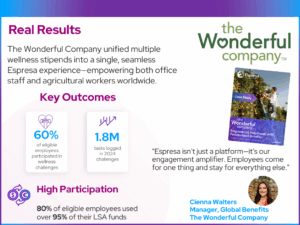
A single hub, especially one that is mobile-friendly, will unify both deskless and desk-bound employees, creating an employee benefits platform with accessible and meaningful benefits. The Wonderful Company took this approach, knowing that their workforce was heavily split among offices and agricultural sites.
With a carefully designed program, they unified their employees and benefits, increasing their employee engagement and sentiment, a key factor in retention.
Self-service
HR managers have supported all employees through their benefits stresses and questions, as they should as leaders of their company’s values. But that time spent assisting employees takes away from their other responsibilities. Losing valuable time, resources, and opportunities to improve their system, rather than putting out fires.
By using a vendor partner with a dedicated support team, an organization can not only load all of their resources onto the platform, but they can also offset the HR burdens by passing benefits questions on to their trusted vendor. Espresa is working to further streamline this process, even allowing AI to streamline eligibility questions (with a human making the final call).
Fill out the form on our Consultants page and ask about Espresa’s AI implementation strategy.
Administrative simplification
Employee benefits platforms and wellness software simplify administrative efforts for HR teams, who are already facing increasing budget cuts that further reduce their effectiveness. Many leaders found the solution in a dedicated employee benefits platform, allowing employees to access benefits easily while HR can keep track of everything in one location.
And with a strong partner like Espresa, HR teams leverage the data and insights provided by the platform, optimizing the experience to reduce employee confusion further.
Popular employee benefits providers
As employee benefits platforms grow, so too do the vendors providing them. While each specializes in different areas, they each have distinct strengths and advantages. The key is finding the employee benefits provider that best suits your organization, identifying the offerings that move the needle.
Espresa vs. Benepass
Flexible benefits define the experiences for Espresa and Benepass, with both platforms prioritizing employee choice and personalization. However, they diverge in their marketplace capabilities, global scale, benefits delivery, and even their engagement tactics. To fully understand how each platform can create distinct benefits for globally -dispersed and generationally diverse employees, read our full comparison.
See the Full Breakdown: Espresa vs. Benepass
Espresa vs. Compt
Espresa and Compt both focus on the simple delivery of flexible employee benefits through their LSA programs. And both enable personalized benefits to shine through employee choice. Their main differentiators lie in their platform’s scope, delivery, global growth capabilities, and the overall employee experience. To fully understand how each benefits provider explores LSA administration, specialty allowances, engagement, and overall workforce support, explore the full comparison of Espresa and Compt.
See the Full Breakdown: Espresa vs. Compt
Espresa vs. Forma
Espresa is often compared to Forma, a strong benefits organization, as they both provide flexible benefits through Lifestyle Spending Accounts. Though both platforms support employee choice and benefits personalization, they differ in how they manage engagement, marketplace capabilities, global scale, and program administration. To best understand the differences between Espresa and Forma, read our full breakdown on each company’s strengths and areas of focus.
See the Full Breakdown: Espresa vs. Forma
What makes a strong lifestyle benefits provider
A strong employee benefits provider not only consolidates all of their programs onto a single platform, but they also elevate it beyond baseline expectations. To fully support an HR team and their employees, employee benefits companies must have five core resources.
Support teams
Access to a dedicated support team alleviates high-stress situations for HR teams, allowing their vendor partner to handle technological or plan questions. This frees up those same HR teams to refine their programs without fear of overlooking employee roadblocks.
Integrations
A platform is only valuable if it is accessible. A strong employee benefits provider needs those connections and integrations with HRIS systems (ADP, Workday, SAP, Namely), communications (G Suite, Outlook, Slack), and single sign-on (Microsoft Azure, Okta, OneLogin). Without them, the platform can fail to connect to each employee and their desired way to work.
Read more: Espresa’s Platform Integrations
In-app communication
In-app communications provide benefits teams with a direct line of communication to their employees, advertising events, leftover funds, and more to ensure employees understand the full breadth of their benefits. They can also more directly control employee engagement, ensuring that employees use their benefits and don’t feel neglected if they forget to spend within a plan term.
Analytics
Measuring analytics is the only surefire way to gauge and improve the program. Analytics are essential to employee benefits providers, since they directly tie to their influence on employees. Espresa, for example, covers a multitude of analytics, which grant exceptional insights into how employees use their benefits.
Organizations often find that broader participation in employee benefits programs is associated with stronger engagement and retention. All data gathered in the platform is for HR teams to learn from, further optimizing their programs to meet the needs of their teams. Without these key insights, HR teams can’t optimize their benefits programs and adapt them to employee preferences and ideas.
See how insights can really improve a benefits program with data from our 2026 LSA Benchmark and Trends Report.
Partners
Lifestyle benefits are sometimes only as valuable as the eligible expenses they permit. That’s why having valuable partners can elevate an employee benefits company, collaborating with others to deliver exclusive experiences. Espresa partners with LifeSpeak to deliver diverse physical and mental wellbeing resources, with exclusive discounts.
Read more: Espresa x LifeSpeak
Elevating employee benefits software without cost inflation
Elevated employee benefits programs do not inherently come with inflated costs. The real key is understanding your employees and where the resources would best be appreciated. And that’s something that traditional benefits can never replicate, and an opportunity for employers to leverage both.
The expected support of traditional benefits complemented by the flexibility of lifestyle benefits, all with predictable budgets and streamlined administration. Especially when consolidated through one platform. Take the next step in employee benefits and see how Espresa compares to other employee benefits providers.