







Employee engagement metrics have never been more important for future-focused organizations. They are indicators of commitment, workplace pride, and motivation. Especially important now as burnout rates continue to rise among employees. But measuring employee engagement is not as simple as asking. It’s reflected in their actions, and right now, their actions imply an engagement vacuum.
Gallup’s research backs this theory, as they’ve found that global employee engagement has fallen for the second consecutive year, sitting around 20%, a new low since the major workplace shifts in 2020. The impact? An estimated $10 trillion in lost productivity.
So, how can employee engagement metrics help offset these intense losses? They’re the starting point—used to inform passionate leaders of faults, shortcomings, or issues within their organizations, and guide them to a budget-conscious solution.
So, when employers are looking to shore up their 2026 engagement strategy, it’s important to consider what employee engagement metrics their team is prioritizing and the impact it has on their employees.
The ROI of employee engagement may seem intangible for many, especially those without a comprehensive benefits or engagement software, as managing every employee’s needs in-house often takes a high toll on HR professionals.
Here’s what we’ll cover:
- What are employee engagement metrics?
- Why do employee engagement metrics matter in 2026?
- Employee engagement metrics worth tracking
- The benefits of employee wellness software
- Creating employee experiences that encourage engagement
What are employee engagement metrics?
Most importantly, what are employee engagement metrics? Employee engagement describes how connected employees feel to their organization, directly impacting their ability to put in extra effort or feel a sense of ownership at work.
Employee engagement metrics are the tools and benchmarks employers use to quantify employee performance and commitment. Based on those metrics, organization leaders can understand the state of their employees’ wellbeing, identifying shortcomings and opportunities for improved support, and adapt their wellness programs accordingly, including initiatives like an employee wellness stipend or flexible lifestyle benefits.
Why do employee engagement metrics matter in 2026?
Metrics for employee engagement are essential for a successful workplace—applicable across any industry. As Gallup’s research has noted, employee engagement has fallen for the second year in a row, resulting in an estimated $10 trillion in lost productivity.
Employee engagement metrics close this gap—identifying potential weaknesses in the organization’s foundation and culture, rather than their sales numbers or client acquisition. But they are inherently linked. Gallup proves this, noting that engaged workforces (those with higher retention, lower absenteeism, and stronger employee performance) have higher earnings per share than their less-engaged counterparts.
Interestingly, the data also suggest that strong employee resilience in these companies led to faster recoveries following the 2008 recession. The economic storm was strong, but their employees were stronger, growing their NPS (net promoter score) faster than those with average engagement levels.
Employee engagement metrics worth tracking
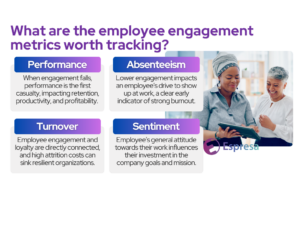
Some of the most common types of engagement metrics include:
Performance
The most understood metric of employee engagement is performance. When an employee is less engaged, their performance falters. Gallup once again argues that performance and engagement are inherently linked, supported by metrics from top- and bottom-quartile businesses. Between the top and bottom, they noticed:
- 23% higher profitability
- 10% higher customer satisfaction/loyalty
- 18% higher productivity
- And more
Absenteeism
Absenteeism refers to an employee’s volume of unplanned absences from work, another metric that directly indicates employee engagement. Within Gallup’s data, they also noted an 81% difference in absenteeism from engaged vs. non-engaged teams. It’s another clear early warning sign of high burnout and low engagement, as employees feel unsupported at work, and sometimes avoid it entirely.
This shouldn’t be viewed as a fault of the employees, but rather an opportunity for employers to learn more about their employees and their productivity blockers.
Turnover
Turnover is another quantifiable measure of employee engagement, and it’s one of the most costly. Replacing a manager or leader can cost upwards of 200% of their salary, with technical professionals costing around 80% of their salary, and frontline employees around 40%.
Read More: The High Cost of Employee Turnover
With high turnover rates, those exceptionally high attrition costs can sink even the most resilient industries. But when high turnover does happen, it’s an opportunity to analyze what can be improved foundationally.
Employee sentiment
A positive employee sentiment goes a long way in measuring engagement. But there’s a key distinction between a satisfied employee and an emotionally invested employee. A satisfied employee does their job, mostly in relation to their pay and benefits rather than a sense of pride or connection to the company.
While this is a fair point of view for employees in a transactional workplace, it ignores the growth opportunities presented by a stronger company culture. Frequent surveys to measure employee engagement and sentiment are a strong start—hearing directly from employees on what challenges they face that employers can alleviate.
The benefits of employee engagement software
The ROI of employee engagement may seem intangible for many, especially those without a comprehensive benefits or engagement software, as managing every employee’s needs in-house often takes a high toll on HR professionals. However, when employers invest in employee engagement software, their HR teams have more room to breathe, while employees gain access to meaningful benefits.
And it’s more than an upgrade to employee benefits, it’s a commitment to their total wellbeing. Offerings like Lifestyle Spending Accounts, or Rewards and Recognition programs, facilitate flexible employee benefits without intense administrative work. And with a partner like Espresa, tracking metrics is simple and insightful, revealing insights into spending habits, event attendance, recent recognitions, and more. All tools to augment the employee experience and make it meaningful beyond the day-to-day work.
Creating employee experiences worthy of engagement
Employee engagement is a business resource. A resource that requires investment to reach its fullest potential, and if ignored, can crack a business’s long-established foundation. While the monetary investment can be minimal, the impact is sweeping.
New employee experiences, like Lifestyle Spending Accounts or Rewards and Recognition programs, have a marked improvement on employee engagement and retention. They create lasting experiences that give employees a reason to care about their workplace beyond clocking in and clocking out.
So when adapting a benefits plan that supports employee engagement, consider a partner with built-in analytics and insights that augment your programs to suit your diverse employee population.