









Employee sentiment is the organizational pulse. If ignored, a company might keep moving for a while, but eventually the whole body grinds to a halt. In the modern workplace, employee sentiment is a leading indicator of company success.
Employee sentiment is often mistaken for just happiness or satisfaction. However, for corporate teams, it’s more accurate to think of sentiment as emotional investment: the collective mood and attitude that employees hold toward their work, their colleagues, and the organization.
While satisfaction is transactional, measuring employee sentiment gets to the heart of employees’ sense of safety and value. And how employees feel drives their behavior at work. According to Gallup, companies with high employee engagement experience 23% higher productivity, 18% higher profitability, and 81% less absenteeism than those with less engaged workers.
With global workers adopting AI faster than ever, AI use is no longer translating into employee confidence. According to ManpowerGroup’s 2026 Global Talent Barometer, the regular use of AI jumped 13% to 45% among workers, while confidence in using technology fell by 18%. For the first time in three years, overall worker confidence declined, bringing the Global Talent Barometer score to 67%.
As AI reshapes work, employees are looking for reassurance, clarity, and tools that help them grow alongside change—not feel left behind. In fact, 43% fear automation may replace their jobs within the next two years, up 5% from 2025. Today’s employees feel capable in their current jobs, but increasingly uncertain about what comes next.
Digital evolution requires workforce adjustment. As AI scales, employee burnout can create friction that slows technology adoption. According to the Aflac WorkForces Report, Gen Z has surpassed millennials as the most burned-out generation, with 74% experiencing at least moderate burnout, compared with 66% of millennials in 2025. Burnout threatens the organizational agility required for success—especially as organizations look to entice the next generation of workers. To improve positive employee sentiment and engagement, leaders must prioritize human resilience as highly as technical updates.
In this article, we will discuss how investing in employee total wellbeing can boost employee sentiment. By supporting employee psychological safety, fostering community, and promoting alignment with mission, vision, and values, companies can foster a confident and resilient workforce, ultimately achieving greater productivity and enduring organizational success.
While sentiment might sound like a soft metric, its impact on an organization’s balance sheet is concrete. When employees feel safe and invested in their workplace community, they shift from surviving to thriving.
Here’s what we’ll cover:
- Measuring employee sentiment: Satisfied vs. emotionally invested
- Employee sentiment analysis: Driving high employee engagement
- Supporting modern healthcare needs with GLP-1 and Specialty Care Accounts
- Total wellbeing support for a people-powered competitive advantage
Measuring employee sentiment: Satisfied vs. emotionally invested
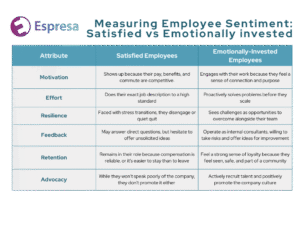
Future-focused leaders must distinguish between a workforce that is simply content and one that is truly committed. While satisfaction indicates that a job is acceptable, emotional investment signals that an employee is empowered.
One of the most effective ways to understand employee sentiment is by regularly surveying your workforce to capture their real-time needs. These check-ins help leaders identify emerging needs early and shape people-first programming that supports wellbeing, belonging, and long-term engagement.
The following table highlights the critical indicators that separate a transactional workplace relationship from a high-sentiment, high-performance culture.
Employee sentiment analysis: Driving high employee engagement
While sentiment might sound like a soft metric, its impact on an organization’s balance sheet is concrete. When employees feel safe and invested in their workplace community, they shift from surviving to thriving. This is the difference between a workforce that merely uses new tools and one that finds ways to evolve.
To bolster employee sentiment and drive company success, organizations must actively and thoughtfully address the fundamental psychological needs of their workforce. Now, salary alone is no longer enough to fully support holistic employee development and wellness. Instead, employees leverage total compensation strategies to close the benefits gap and provide care for critical needs.
These core needs coalesce around three critical pillars that underpin a truly engaged and high-performing culture: feeling valued and secure, fostering a strong sense of belonging and community, and cultivating a genuine belief in the company’s mission, vision, and values.
Bolster individual value and safety
The measure of value focuses on the individual’s day-to-day experience. In a corporate setting, unmet needs can turn into cynicism. When employees feel valued, they feel greater autonomy. High sentiment teams don’t feel micromanaged; they feel empowered to solve problems.
Psychological safety comes when employees know they won’t be punished or humiliated for speaking up with ideas, questions, concerns, or mistakes. Psychological safety is the #1 driver of high-performing teams. Knowing they are valued and safe helps employees thrive and see their current role as a bridge to a better future.
Foster a sense of belonging and community
Belonging is the sense of connection employees feel with their peers, allowing them to bring their authentic selves to work. A culture of inclusion ensures that every team member feels accepted and valued, eliminating the need to hide their true identity to fit in.
Rewards and Recognition programs move beyond the annual bonus, utilizing peer-to-peer platforms where praise is frequent, informal, and visible. When tangible rewards, such as points redeemable for meaningful experiences, back this praise, a simple thank-you transforms into a measurable sense of worth.
Collaboration cultivates community. Leaders must ensure that getting work done is frictionless so sentiment can thrive. By prioritizing frequent praise and seamless collaboration, organizations create a self-sustaining environment. A proactive approach prevents employee burnout and turnover, motivating employees to support one another and drive the collective mission forward.
Inspire belief in mission, vision, and values
Honest, competent, transparent leadership boosts employee sentiment. Strategic clarity makes work meaningful, ensuring that daily tasks feel purposeful and contribute to a larger goal. Elevate employee sentiment by ensuring employees understand the why behind their projects and their connection to the company’s overall mission. Remember that busy work is a profound destroyer of positive employee sentiment. It leads to frustration, disengagement, and a feeling that energy and efforts aren’t valued.
Teams thrive when they are provided with necessary resources, such as an adequate budget, sufficient headcount, up-to-date tools, and the training to achieve ambitious goals. This investment builds trust, boosts motivation, and demonstrates management’s commitment to the team’s success.
When all three of these core aspects of total employee wellbeing are clearly defined and supported, employees thrive.
The power of specialty allowances
In an era when workers fear automation and feel uncertain about their professional futures, generic, one-size-fits-all benefits can feel uninspired. To bolster sentiment, future-focused leaders have shifted toward personalized benefits that align with an organization’s values and their employees’ needs.
Lifestyle Spending Accounts (LSA) are the premier tool for this shift. By providing a dedicated budget that employees can use for their specific needs, whether specialized career coaching, wellbeing benefits, or family care services, personalized benefits send a powerful message: we see and care about you as an individual.
By funding an employee’s unique lifestyle through specialty allowances, companies directly affirm individual value and psychological safety.
Supporting modern healthcare needs with GLP-1 and Specialty Care Accounts
As employers navigate rising healthcare costs and evolving wellness priorities, personalized benefits are becoming more essential than ever. One growing area of need is access to specialty care support, including GLP-1 weight management medications and related treatment programs.
Through Specialty Care Accounts and LSAs, employers can offer flexible funding that helps employees pursue the care that’s most relevant to them. Whether that includes metabolic health support, chronic condition management, hormone replacement therapy, or other emerging health services not always covered by traditional plans.
By meeting employees where they are, organizations reinforce a powerful message: your wellbeing matters, and you’re supported for the long term. This commitment proves the organization prioritizes the people who drive its mission forward and what matters to them. Ultimately, such targeted investment transforms a standard benefit into a powerful vote of confidence in every employee’s future—reinforcing employee loyalty and longevity.
Total wellbeing support for a people-powered competitive advantage
Total wellbeing support is the final, essential bridge between employee sentiment and organizational resilience. By moving beyond traditional benefits, leaders can provide a comprehensive safety net that empowers employees to thrive. Whole-person support extends beyond physical wellbeing to encompass mental health, financial wellbeing, and flexibility.
Frictionless access to mental health tools unlocks the emotional bandwidth essential for innovation, while robust financial wellness resources ease financial anxiety, refocusing energy on professional growth. And time is the ultimate currency. Flexible schedules and recharge days directly boost sentiment and honor life beyond the office. Support for employee total wellbeing prevents burnout, forges lasting loyalty, and elevates employee sentiment.
It’s more than a metric; it is the primary indicator of your organization’s endurance. Human confidence and resilience remain the true variables in the equation of success. Companies that will thrive in the coming years are not the ones with the fastest tech tools, but the ones with the most emotionally invested people.
By moving beyond transactional satisfaction and investing in flexible benefits, total wellbeing, and authentic recognition, smart leaders accelerate their path to enduring success. Invest in people, your people, so they’ll stay invested in your organization.
Connect with Espresa today to request a demo and see how the all-in-one LSA Plus™ platform can turn your benefits strategy into a powerful competitive advantage.