







If the last few years were about expanding the safety net for employees, 2026 will be defined by optimizing it. As the next plan year approaches, HR leaders and benefits strategists face a familiar tension: rising costs alongside a multi-generational workforce that expects more support than ever.
The era of “one-size-fits-all” benefits is over. In 2026, the competitive edge will go to companies with the smartest plan design. Willis Towers Watson found that in 2025, rising benefits costs became the #1 concern for employers in 2025. In this new age of precision benefits, connection, empathy, targeted flexibility, and choice converge to make every dollar count.
The rise of Lifestyle Spending Accounts (LSA) has helped bridge the generational differences between Gen Z and Boomers and leveled the benefits playing field for distributed teams. At the same time, growing demand for specialty medications is reshaping pharmacy contracts. The strategies future-focused leaders implement in 2026 will determine their ability to retain talent in a high-cost environment.
As employers face growing demand for high-cost treatments like GLP-1s, hormone therapy, and mental health services, many are turning to Specialty Care Accounts–fixed, predictable allowances that expand access to modern care without destabilizing the core medical plan.
In this article, we’ll explore the top five employee benefits trends defining the 2026 landscape and how forward-thinking employers can turn these challenges into their strongest retention tools.
Here’s what we’ll cover:
- Market forces driving a smarter benefits strategy
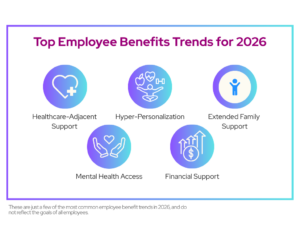
- Top 5 employee benefits trends for 2026
- Transform your benefits strategy
Market forces driving a smarter benefits strategy
The 2026 employee benefits landscape is driven by three primary factors that are placing unprecedented financial and competitive pressure. Rising healthcare costs remain the top challenge, with employer health benefit costs projected to increase by an average of 6.5% to 9% in 2026, according to a survey by Mercer, largely driven by medical inflation and the increasing utilization of specialty drugs.
At the same time, persistent employee financial stress continues to intensify as inflation remains elevated, forecasted to hover near 3% in the first half of 2026. As salary budgets moderate, workers are increasingly looking to their employers for meaningful financial wellness and cost-of-living support.
Finally, workforce demographics are rapidly shifting. Millennials and Gen Z are projected to account for approximately 74% of the global workforce by 2030, according to a Deloitte survey. And nearly half of Gen Zs and millennials report feeling financially insecure, up sharply from 30% of Gen Zs and 32% of millennials in the previous year’s survey. Across life stages, employees are navigating a wider range of financial and medical pressures, driving demand for benefits that are both flexible and precisely targeted. Personalized, values-driven benefits are no longer a differentiator–they are foundational to engagement across every generation.
Top 5 employee benefits trends for 2026
1. Healthcare adjacent benefits
With healthcare costs projected to rise by 8–10% in 2026, HR leaders are moving beyond simple cost-shifting to strategic cost management. A primary driver of this trend is the exploding demand for GLP-1 weight-management drugs.
More employers are extending flexible benefits into health-adjacent areas such as medical travel, pharmacy support, and specialty stipends for fertility or high-cost care. While still representing a low percentage of plans, these programs are growing, reflecting an early shift toward targeted affordability and access. And they allow employers to preserve predictable costs while expanding access to care categories that may be excluded or tightly managed under traditional plans.
Expect rigorous utilization management, linking coverage for expensive medications directly to participation in incentivized wellbeing programs.

2. Hyper-personalization
The one-size-fits-all benefits package is outdated. Escalating healthcare and drug costs have created a breaking point: employers need benefits that deliver more with less. In 2026, the trend will continue to shift toward Lifestyle Spending Accounts (LSA) that give employees the freedom to spend money on whatever they value most.
While LSAs excel at providing everyday personalization, they are not designed to address high-cost, clinically driven care. Employers must therefore pair LSAs with targeted medical strategies to ensure coverage for more complex or specialized needs.
This balance between personalization and structured care is a major reason LSAs dominate the benefits conversation in 2026. They bridge the multi-generational gap. A Gen Z employee might use their LSA for a gym membership or student loan repayment, while a Baby Boomer might use the same funds for financial planning or pet insurance.
Espresa benchmark data reinforces this shift, showing that employees are increasingly directing flexible benefit dollars toward personalized wellness support and emerging care categories, underscoring how quickly expectations around customization are evolving.
3. Expanded family support
Caregiving benefits are expanding beyond standard parental leave to cover the entire lifecycle of a family. This need is driven by the sandwich generation, caregivers for both children and aging parents simultaneously. Subsidized backup care for aging parents and access to care navigators (experts who help manage Medicare/Medicaid paperwork and nursing home selection) are essential.
A specific surge in benefits covering menopause support, including telehealth and hormone therapy access, and complex fertility treatments, is predicted to become a standard competitive differentiator in 2026.
4. Financial support as a core wellbeing benefit
Financial stress is inextricably tied to overall health. For many employees, one unexpected medical or family expense is enough to derail years of careful financial planning. As inflation impacts long-term savings, financial wellness programs are moving from nice-to-have educational seminars to mission-critical financial wellbeing support and coaching.
With recent Secure Act 2.0 provisions, more employers in 2026 will treat student loan payments as retirement contributions, providing a 401(k) match based on the employee’s loan repayments.
Payroll-deducted emergency funds that help employees build a safety net automatically, reducing the likelihood they will borrow against their retirement funds.
5. Mental health access
While mental health coverage is now standard, the 2026 trend focuses on access, quality, and preventative care. Employers are finding that access to an app is not enough. Attention is turning to insurance carriers to demonstrate they have sufficient in-network therapists to support employees’ needs.
A shift from reactive sick days to proactive wellness days that employees are encouraged to take, specifically to disconnect and recharge before burnout sets in.
Transform your benefits strategy
2026 is shaping up to be a defining moment when strategic benefits design becomes an absolute necessity. HR leaders must act with precision and purpose when facing double-digit cost increases in healthcare, and the complex, diverse needs of a multi-generational workforce demand that. Benefits with targeted flexibility, such as Specialty Care Accounts, can strategically turn external pressures into an internal source of strength.
The core mission for 2026 is clear: offer the right benefits at the right time to maximize engagement. The organizations that win in 2026 won’t be the ones that spend the most; they’ll be the ones that design benefits with the most precision.
Ready to See Espresa in Action? Discover how HR leaders are using Espresa to boost employee engagement, retention, and workplace culture. Schedule a demo today to explore how we can support your team’s unique needs globally and equitably.