









The talent landscape has shifted dramatically in recent years, and leaders who proactively build a winning total rewards strategy give their organizations a competitive advantage. Employee expectations have evolved, and workers continue to look for fulfilling work, flexibility, and a strong company culture.
Companies face fierce competition for skilled employees. Even as labor market conditions fluctuate, recruitment remains difficult. According to a poll from Employ Inc., 81% of recruitment professionals say filling roles is a challenge. As businesses adjust and right size their operations for their needs, they ask more of their existing workforces, putting strain on reward and compensation strategies. A robust total rewards strategy is necessary to stay competitive.
In this article, we’ll explore how organizations can build a winning total rewards strategy that attracts, engages, and retains top talent. We’ll also explore the key elements of total rewards, their business value, and implementation strategies. When designed effectively, a total rewards benefits package can be a valuable tool to improve enrollment and retention, offering employees more flexibility and control.
Here’s what we’ll cover:
- What is a total rewards strategy?
- Total rewards as a talent advantage
- The 5 core components of total rewards
- What happens when employee total rewards fall short
- Practical tips to build a total rewards program
- Measuring the ROI and impact of total rewards
- The future of total rewards strategies: flexibility, inclusion, and employee choice
What is a total rewards strategy?
A winning total rewards strategy offers a holistic approach to employee compensation and benefits. It is the collection of salary, benefits, and wellbeing initiatives that shape an employee’s total compensation.
Total rewards go beyond basic benefits to include professional development, employee recognition, and wellbeing support. By addressing key needs—financial security, wellbeing, appreciation, and growth—strong total rewards programs increase employee engagement, cultivate loyalty, and improve outcomes.
Lifestyle Spending Accounts (LSA) are a flexible perk that can strengthen a total rewards strategy. Designed to adapt to changing employee needs, they allow organizations to quickly adjust benefit offerings as workforce expectations evolve.
Explore: Resources that Support Total Rewards Strategies
Total rewards as a talent advantage
The talent market remains tight, and candidates are more selective than ever. They are not just looking for a job; they are searching for purpose, balance, and a workplace that reflects their values.
A thoughtfully designed total rewards system gives employers a clear advantage. By combining competitive compensation with flexible benefits, wellbeing support, and meaningful recognition, organizations signal that they invest in their people. This isn’t a nice-to-have. It’s a strategic advantage.
When total rewards benefits packages are more diverse, employees are more inclined to stay with their current employer.
Read More: The True Cost of Employee Turnover, and 4 Ways to Keep Them
The 5 core components of total rewards
The key elements of a total rewards strategy are compensation, inclusive benefits, wellbeing programs, recognition, and development. Each element works together to attract talent, retain employees, and motivate your workforce.
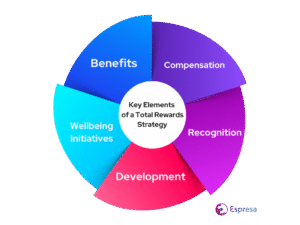
1. Compensation
Top talent expects more than a base salary. Employers can strengthen compensation strategies with bonuses, commissions, flexible reimbursements, and long-term incentives such as profit-sharing programs.
2. Benefits
Beyond financial compensation, benefits are a foundational part of a total rewards strategy. Health insurance, paid time off, dental and vision plans, and retirement savings plans demonstrate care for employees’ wellbeing. Personalized benefits can further enhance a rewards program.
3. Wellbeing initiatives
Modern wellbeing initiatives take a holistic approach to total wellbeing that supports employee health, happiness, and resilience. These programs encourage healthy habits and provide mental health support across different life stages.
4. Recognition
A comprehensive recognition strategy ensures employees feel valued. Peer-to-peer recognition, leadership acknowledgment, and company-wide celebrations foster connection and engagement.
5. Development
A growth mindset strengthens development strategy through training, mentorship, tuition reimbursement, and ongoing learning opportunities. Supporting employee growth keeps teams engaged and future-ready.
What happens when employee total rewards fall short
Understanding employee total rewards is essential to gauge performance and organizational impact. Espresa’s 2026 Benchmark and Trends Report shows a strong connection between benefits design, employee engagement, and productivity.
When employers leveraged 6–8 categories in their LSA plans, participation, cost-efficiency, and inclusion performed the highest. Similarly, strategies that combined multiple Espresa solutions yielded the highest sustained engagement (24% greater), despite lower wallet funding—showing that thoughtful design can be both cost-effective and engaging.
Read more about the influences of benefits and salary on employee engagement.
Practical tips to build a total rewards program
So, how can companies offer wellness benefits as part of their total rewards? The first step is understanding the workforce you serve. Today’s employees, particularly younger generations, value balance and purpose-driven work.
Future-focused organizations evolve their rewards program to reflect workforce needs and expectations. Here are key tips for developing a successful total rewards strategy:
Start with employee needs
Building a comprehensive total rewards strategy starts with listening. Surveys, focus groups, and one-on-one conversations help uncover employee priorities, while benefits usage data can reveal gaps, underutilized offerings, and opportunities to improve.
Employee needs vary widely based on personal circumstances, health considerations, and lived experiences. Embracing flexibility and customization through inclusive benefits design promotes health equity and ensures employees feel valued, supported, and able to thrive both inside and outside of work.
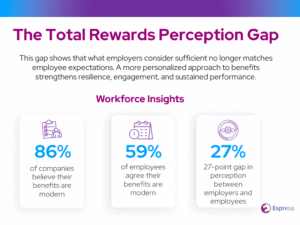
Benchmark your competition
Knowing the competition keeps organizations ahead in today’s dynamic talent market. Leading companies like Airbnb, Avalara, JM Family, Nielsen, Pinterest, and Procore offer inclusive and customized benefits that recognize the power of people-first strategies.
Identify what top employers in your industry are offering, whether it’s flexible work, wellness support, or personalized reimbursement programs. Understanding these trends can help you evaluate where your current offerings align, and where there may be opportunities to improve.
Offer benefits that stand out
Future-focused leaders enhance rewards strategies with benefits that go beyond salary. Prospective employees increasingly want flexibility and work-life balance.
Remote or hybrid work, compressed schedules, childcare support, student loan repayment, and sabbaticals can set employers apart.
Design for flexibility and personalization
Standard benefits packages are no longer enough. Employees want personalization—whether through language training, pet care support, gym memberships, or family-friendly benefits.
LSAs offer the ultimate choice and customization to meet diverse employee needs.
Make employee wellbeing a core strategy
Employee wellbeing is a strategic imperative. A healthy workforce is a powerhouse of productivity, creativity, and engagement. Investing in employee wellbeing is the future of effective total rewards plans.
Holistic wellbeing strategies may include mental health support, financial counseling, mindfulness resources, and wellbeing partnerships that help employees thrive.
Build recognition into culture
Employees crave appreciation, especially when they go above and beyond. Public recognition builds confidence and reinforces contributions.
A holistic rewards and recognition program where everyone can have a voice of praise drives engagement for more meaningful, personalized experiences. Multiple recognition channels for praise, such as peer-to-peer recognition, social media shout-outs, and customized rewards, create meaningful employee experiences.
Align benefits with company mission, vision, and values
Comprehensive benefits reflect company culture and values. Aligning benefits with organizational priorities attracts employees who share the mission.
For example, innovation-driven companies may invest in learning stipends, while socially-active organizations may offer paid volunteer days.
Measuring the ROI and impact of total rewards
Measuring the Value-on-Investment (VOI) of total rewards programs comes down to tracking participation, utilization, and employee impact over time.
For example, JM Family unified their wellness and reimbursement programs into a single total rewards platform. In the first year (2024), 87% of employees accessed the platform and 78% submitted at least one claim.
A year later, participation continued to grow: in 2025, claims rose 18% year-over-year, with 89% of employees actively engaging in the program.
Total rewards strategies also benefit HR and finance teams by improving cost control and reducing administrative complexity. Flexible tools like Lifestyle Spending Accounts (LSA) can help organizations deliver high-impact benefits while keeping spending predictable.
Read the Full JM Family Case Study
The future of total rewards strategies: flexibility, inclusion, and employee choice
The future of total rewards strategies is guided by employee demand for more holistic, flexible offerings. Diverse benefits platforms–including LSAs, recognition programs, and community building tools–will continue to shape the next generation of rewards strategies.
Employers will increasingly differentiate themselves through inclusive, adaptable programs that support the full employee experience.